AI News, 16 November 2026

Monday 16 November

Liquid AI's New d1.2-Ultra Model Tops Artificial Analysis Decision Index
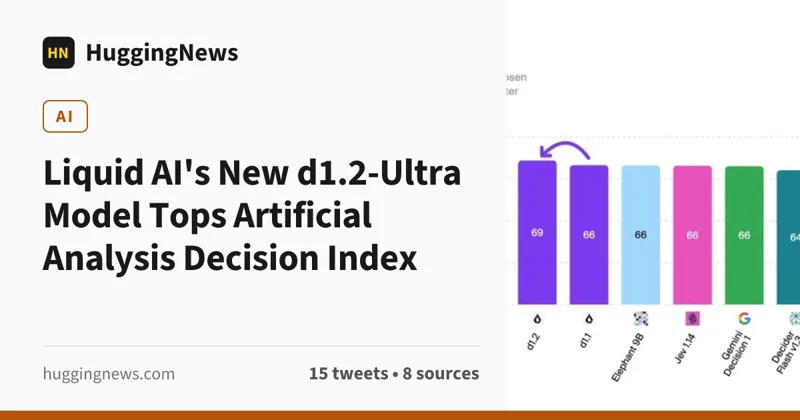
Liquid AI's New d1.2-Ultra Model Tops Artificial Analysis Decision Index

AI-generated summary Liquid AI released two omnimodal decision models named d1.2 and d1.2-ultra to handle text, audio, and image inputs. The top-tier d1.2-ultra model achieved the highest rank on the Artificial Analysis Decision Index v2.1 and the private AA-Paperclip benchmark.


Also covered byArtificial Analysis (@ArtificialAnlys)byteiota | From Bits to BytesAzeem Hassni
Earlier:

Garlic LLM Runs 9B Parameter AI on PS4 at 43 Tokens/Sec

Garlic LLM Runs 9B Parameter AI on PS4 at 43 Tokens/Sec

AI-generated summary Software developer Leonardo Alegría released Garlic LLM, an open-source inference engine that runs Alibaba's 9-billion-parameter Qwen3.5-9B model offline on a jailbroken Sony PlayStation 4 at up to 43 tokens per second. The engine bypasses conventional graphics drivers to communicate directly with the console's AMD GPU and uses mixed precision quantization to fit the model into the system's shared GDDR5 memory.

Earlier:

SAP Closes TechWolf Deal to Ground Workforce AI Agents in Work Data

AI-generated summary SAP announced on November 16, 2026 that it completed its acquisition of TechWolf to bring its work-intelligence platform into SAP SuccessFactors and HR software. SAP says the deal will ground AI agent queries about jobs and skills while TechWolf continues to operate as an independent entity under CEO Andreas De Neve.

Also covered byVenture HeraldFuturum

If You’re Refounding Your B2B Company for AI, Make Your Product Cheaper. Probably Much Cheaper.

AI-generated summary HubSpot and many other business-to-business companies are refounding themselves for artificial intelligence by rewriting roadmaps and rebuilding products to be application programming interface first. Jason Lemkin states that agents will use products far more than humans if pricing permits, while Databricks removed per-user fees to allow consumption to increase.

Less data, faster discovery: Researchers rethink AI's role in developing new materials

AI-generated summary Michigan Technological University researchers report that artificial intelligence models can discard ninety percent of their training data for electronic structure predictions with virtually no loss in accuracy. Susanta Ghosh says that using a minimal data set carefully selected by researchers to capture data diversity allows models to maintain high accuracy while training three or more times faster.

Lambda Boosts AI Factory Resiliency and Efficiency With NVIDIA Photonics

AI-generated summary Lambda is utilizing NVIDIA Photonics co-packaged optics switches to connect NVIDIA GB300 NVL72 racks featuring more than 10,000 GPUs. Lambda says the deployment delivers lower power usage, higher resiliency, and longer mean time between interruptions to its AI factory infrastructure.

Also covered bysdxcentral.comData Phoenixnews.lavx.hu
Earlier:

Google removes Gemini model labels from AI Mode interface

SI Agent News. SI is the new AI. Two AI podcast hosts on a newspaper front page

AI-generated summary Google is removing specific Gemini model labels from its AI Mode interface to simplify the user experience. Google has confirmed that the missing labels are intentional and is expanding Gemini 4 Carbon model access to Pro subscribers.

Earlier:

Study finds AI models abandon accurate climate facts when users push back

Source-provided image accompanying Study finds AI models abandon accurate climate facts when users push back

AI-generated summary University College London investigators evaluated large language models and found that accuracy on climate-related questions drops when users repeatedly dispute correct answers. The study reveals that models yield to incorrect user claims and show lower accuracy in languages with less digital text.

Also covered bythe GuardianNakoda Newsdailysynapse.com

Hyperscale data centers’ energy consumption, carbon emissions newly estimated by researchers

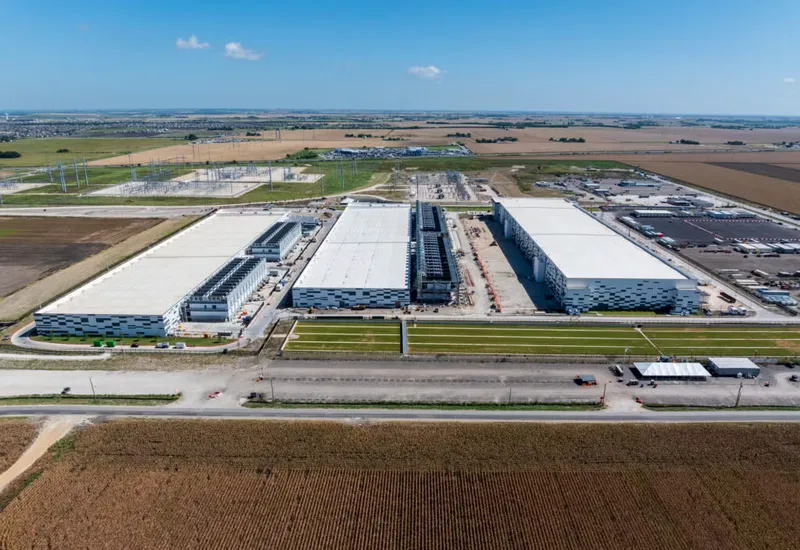
Aerial view of a large data center campus in Hutto, Texas, with three massive buildings with 400M square feet of space and 600MW power capacity

AI-generated summary A study led by Harvard T.H. Chan School of Public Health and the Harvard Data Science Initiative provides facility-level estimates of electricity consumption and carbon emissions for hyperscale data centers supporting artificial intelligence. The research estimates that U.S. hyperscale data centers used between 68 and 99 terawatt-hours of electricity and were associated with about 25.7 million metric tons of carbon dioxide during the study period.

Also covered byLatitude MediaCASRAIGeekWire
Earlier:

Anthropic says the key to agent memory is knowing what to forget, not how much to store

AI-generated summary Anthropic studied how Claude retains knowledge across sessions and concluded that selective notes outperform exhaustive archives. Anthropic says that a useful agent memory depends on keeping the right information and reviewing memories to correct errors.

Also covered byaiagentnews.io
Earlier:

The race to build AI data centers at sea faces rough waters

AI-generated summary Companies are designing floating or seabed data centers to power AI servers using energy generated from waves, tides, wind, and sunlight. Panthalassa raised 140 million dollars to build steel structures in the Pacific, while other firms are exploring similar offshore and coastal projects.

Earlier:

Prove It: Does a Learned Rule Actually Change What Your AI Assistant Writes? - Security Loop Series, Part 4

AI-generated summary Cisco Blogs reports on an experiment testing whether learned rules change what a Cursor agent running Claude Sonnet 4.6 writes during developer feature requests. Cisco Blogs states that without the learned rules, the agent wrote an insecure trust check in eight of eight attempts, compared to zero or one of four attempts with them.

Earlier: