
lotook.com

Wednesday 18 November

Introducing GPT-6.2 Astra and Sol

AI-generated summary OpenAI says it has introduced GPT-6.2 Astra and GPT-6.2 Sol as new models designed for professional work and everyday tasks. OpenAI says GPT-6.2 Astra delivers improved performance on complex professional assignments while GPT-6.2 Sol offers efficient capabilities for everyday use.

Also covered byRSS.bz9to5MacLotook
Earlier:

Monday 16 November

Qwen4-Max vs GPT-6.1 Sol: Five tasks and their costs

AI-generated summary Kingy AI reports that Qwen4-Max and GPT-6.1 Sol met acceptance rubrics on four of five initial synthetic work tasks. Recorded API charges totaled $0.4617003 for Qwen and $0.3134626 for Sol across the first attempts.

Also covered byArtificially NerdyLotook
Earlier:

Saturday 14 November

Gemini 4 Hydrogen is Google's new workhorse for AI agents, and what European teams should check first

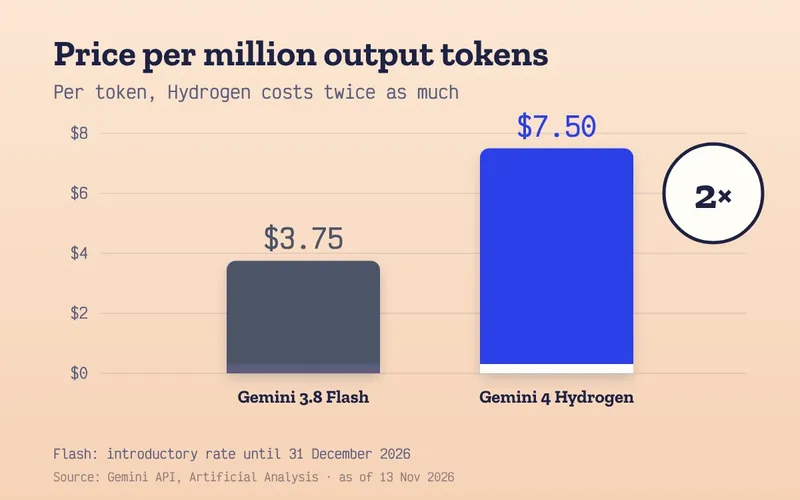
AI-generated summary Google launched Gemini 4 Hydrogen on 12 November 2026 to replace Gemini 3.8 Flash in the Gemini app, Google Search and the Gemini API. Artificial Analysis reports that Gemini 4 Hydrogen scores 51 on the Intelligence Index and costs $1.50 per million input tokens.

Also covered bySilicon AI NewsWritebleLotook
Earlier:

What Is an Embedding in AI? Vectors and RAG

A dark indigo vector space with three glowing clusters of points, and a brighter query spark sitting close to the amber cluster

AI-generated summary An embedding in AI is a numerical vector representing text or other data in a mathematical space and machine learning models use vector embeddings to measure relatedness between concepts, power semantic search, and retrieve relevant context in RAG systems. OpenAI says its third-generation embedding models set default output lengths at 1536 dimensions for text-embedding-3-small and 3072 dimensions for text-embedding-3-large while developers can call text-embedding-3-large with dimensions set to 1024, trading a small amount of accuracy for compatibility and smaller storage footprints.

DeepSeek opens its app’s search, file and voice tools through its API

A smartphone displaying the DeepSeek app on a light wooden table.

AI-generated summary DeepSeek opened the search, file-reading, voice and safety functions behind its consumer app to developers through its API on 13 November. The deepseek-flash model serving these features is currently backed by the DeepSeek-V4.1-Flash-1017 checkpoint.

Also covered byAI Industry TodayCASRAILotook
Earlier: