
rss.bz · Wed 18 Nov

Wednesday 18 November

Introducing GPT-6.2 Astra and Sol

AI-generated summary OpenAI says it has introduced GPT-6.2 Astra and GPT-6.2 Sol as new models designed for professional work and everyday tasks. OpenAI says GPT-6.2 Astra delivers improved performance on complex professional assignments while GPT-6.2 Sol offers efficient capabilities for everyday use.

Also covered byRSS.bz9to5MacArtificialWatch
Earlier:

OpenAI GPT-6.2 Astra, and GPT-6.2 Sol are now generally available on Amazon Bedrock - AWS

AI-generated summary Amazon Web Services announces the general availability of OpenAI GPT-6.2 Astra and GPT-6.2 Sol on Amazon Bedrock. OpenAI states that GPT-6.2 Astra brings frontier-level reasoning for complex business problems while GPT-6.2 Sol is designed for recurring coding workflows.

Also covered byBloombergSI Agent NewsRSS.bz
Earlier:

Google prepares new Gemini 4 Neon model for paid users

SI Agent News. SI is the new AI. Two AI podcast hosts on a newspaper front page

AI-generated summary Google is preparing a new Gemini 4 Neon model that surfaced in code references within the Gemini web app and the Google Cloud SKU catalog. The Google Cloud catalog lists text processing for the model at $3 per million input tokens and $15 per million output tokens.

Also covered byIFAIUnite.AIRSS.bz
Earlier:

Mistral Vibe Desktop Brings Local and Cloud Coding

Mistral Vibe Desktop Brings Local and Cloud Coding

AI-generated summary Mistral has made Vibe Desktop generally available for macOS and Windows to support local repository coding and managed cloud sandboxes. Mistral says the application shares the Vibe CLI core agent engine while offering parallel sub-sessions and background command controls.

Also covered byRSS.bzAI PingAITOP

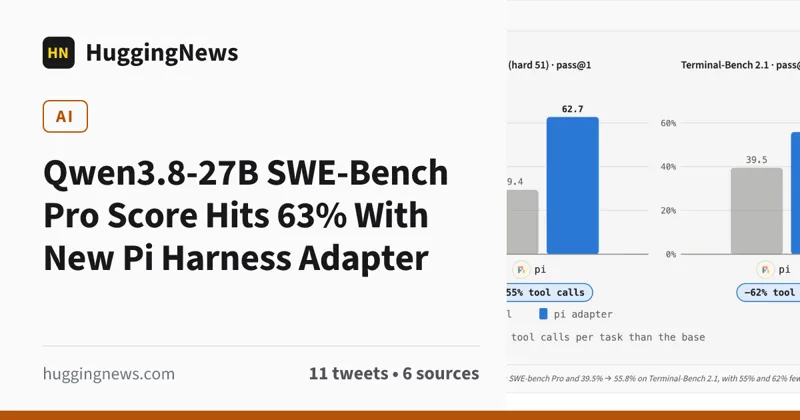
Qwen3.8-27B SWE-Bench Pro Score Hits 63% With New Pi Harness Adapter

Qwen3.8-27B SWE-Bench Pro Score Hits 63% With New Pi Harness Adapter

AI-generated summary A new LoRA adapter for Alibaba's Qwen3.8-27B model increased its pass at one score on the SWE-Bench Pro Hard 51 subset from twenty-nine percent to sixty-three percent when paired with the Pi harness. The developers trained the adapter using reinforcement learning through TRL's AsyncGRPOTrainer and OpenEnv while employing real Pi sessions in a Hugging Face sandbox.

Also covered byRSS.bzSignalHigh