AI News, 14 November 2026

Saturday 14 November

7 AI stories from November 13-14, 2026: GitHub triples its Copilot model picker in a week, locks in a December 14 cutoff, xAI's Grok Bot goes full-team, and four more Copilot, Qwen, and Claude Code updates

AI-generated summary GitHub integrated Gemini 4 Hydrogen into its Copilot model picker on November 13, offering a Flash-class model built for fast agentic coding and multistep workflows. GitHub also announced a December 14 retirement date for six older models across all surfaces, including GitHub Copilot Chat, inline edits, and agent modes.

AI Pentesting Orchestrators: ARTEX’s Ban Created 50 New Tools

AI-generated summary Google Cloud Threat Intelligence classifies AI pentesting orchestrators as a distinct threat category following the creation of fifty new tools after the removal of ARTEX. Cloudflare reports a thirtyfold increase in daily automated requests against its customers while GitGuardian documents how agents query public repositories for secrets.

Earlier:

A $1 Billion First Round for Research Run by Agents

AI-generated summary Mirendil raised $1 billion in its first institutional round led by Kleiner Perkins and Clearlake Capital, with participation from Google, Battery Ventures and M13. The company founded by former Anthropic researchers is building systems that run experiments using agents working under human direction.

Earlier:

What Is an Embedding in AI? Vectors and RAG

A dark indigo vector space with three glowing clusters of points, and a brighter query spark sitting close to the amber cluster

AI-generated summary An embedding in AI is a numerical vector representing text or other data in a mathematical space and machine learning models use vector embeddings to measure relatedness between concepts, power semantic search, and retrieve relevant context in RAG systems. OpenAI says its third-generation embedding models set default output lengths at 1536 dimensions for text-embedding-3-small and 3072 dimensions for text-embedding-3-large while developers can call text-embedding-3-large with dimensions set to 1024, trading a small amount of accuracy for compatibility and smaller storage footprints.

Thousands of Lovable apps expose passports, chats and payment data without a login

AI-generated summary Lovable uses an AI agent to build apps and connect databases in a process called vibe coding. An investigation by Crissy Field and Handelsblatt found that thousands of these apps exposed private data without requiring a login.

Also covered byYESODIThe Kernel PostHIMIAO Horizon

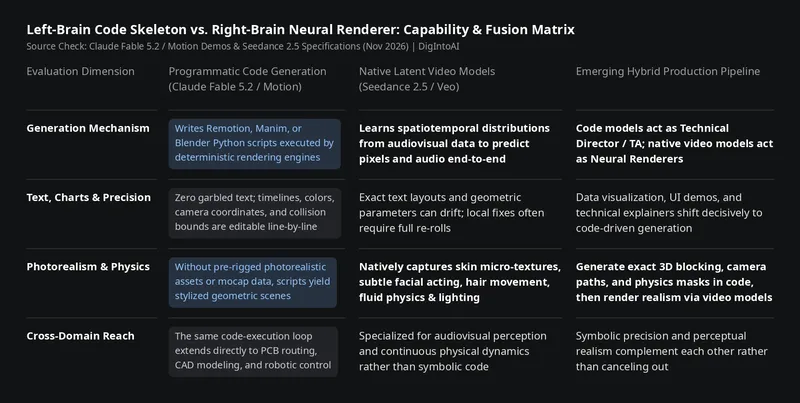
How Frontier AI Diverged in Late 2026: Code Synthesis, External 1M Context, and Native World Models

Figure 2 Programmatic code generation (left brain) versus native latent video models (right brain)

AI-generated summary Between October and November 2026, major artificial intelligence labs released new models including Claude Fable 5.2, Mythos 5.2, Gemini 4 Argon, Gemini 4 Carbon, Gemini 4 Hydrogen, and Seedance 2.5. Anthropic researchers invoked Richard Sutton's Bitter Lesson after the release of Claude Fable 5.2 to explain how strong symbolic reasoning allows general models to operate external engineering toolchains directly.

Why OpenAI Targets Chinese Open-Weight Pricing With Luna

AI-generated summary OpenAI CFO Sarah Friar stated that Chinese artificial intelligence models being cheaper is a myth, arguing that OpenAI's lightweight Luna model costs roughly one-fifth to one-sixth as much to call as Chinese open-weight competitors. OpenRouter data shows that seven of the ten most-used models by token volume over the past month came from Chinese open-weight labs, with DeepSeek and Z.AI holding the top spots ahead of Luna.

Army CID looking for new commercial software tools to monitor darknet, encrypted messaging platforms

AI-generated summary The Department of the Army Criminal Investigation Division seeks commercial software tools utilizing artificial intelligence and machine learning to monitor darknet spaces and encrypted messaging platforms. The organization released a request for information to find technologies that can track foes using applications such as Signal, Telegram, and Discord to plan actions against the military.