
AI News, 17 November 2026

Tuesday 17 November

Transformers.js: Running AI Models Directly in the Browser

AI-generated summary Transformers.js is an open-source JavaScript library developed by Hugging Face that lets developers run pretrained machine learning models directly inside web browsers and JavaScript runtimes. The library supports tasks such as text classification, sentiment analysis, image classification, audio processing, and feature extraction using pretrained models from the Hugging Face Hub.

Bharat Semi Raises $24M to Build AI-Integrated Image Sensors

AI-generated summary Bharat Semi secured $24 million in an all-equity seed funding round led by Info Edge Group, South Park Commons, and Indusbridge Ventures. The New Delhi semiconductor startup will use the capital to develop AI-enabled programmable image sensors and expand its engineering team.

Also covered byThe TerminalChip Dispatch
Earlier:

Helsing unveils Clarity, a sovereign European AI targeting platform to rival Palantir’s Maven

Source-provided image accompanying Helsing unveils Clarity, a sovereign European AI targeting platform to rival Palantir’s Maven

AI-generated summary Helsing unveiled an artificial intelligence targeting platform named Clarity that processes multiple intelligence streams to generate recommendations for human operators. The company states that the software will be delivered to the German army's Lithuania brigade within months.

Earlier:

Anthropic IPO Puts $900 Billion Of Compute Bills On Public View

AI-generated summary Anthropic has entered into aggregate purchase commitments and lease agreements totaling $900.9 billion, which substantially relate to compute and infrastructure for frontier AI models. The initial public offering registration statement reveals that these financial obligations extend through 2045 and include agreements with Google, Amazon, Microsoft, SpaceXAI, Nscale, and Lambda.

Also covered byFinancial TimesZeniteqNikkei Asia
Earlier:

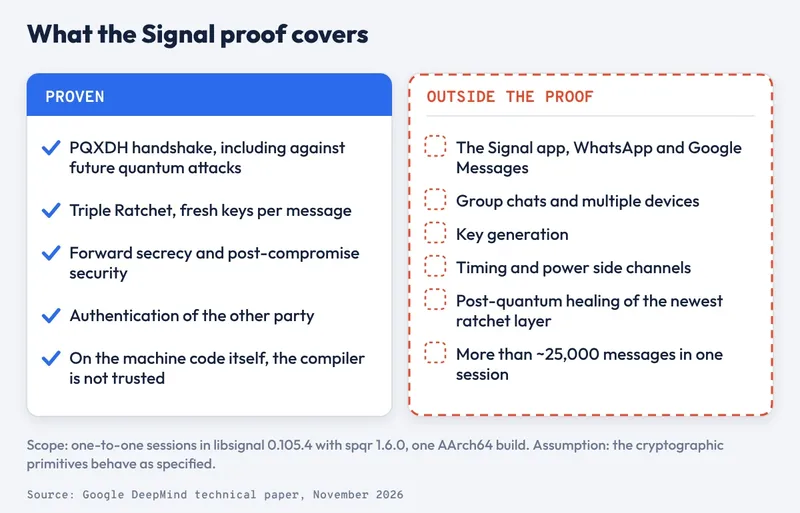
DeepMind AI agents prove security of compiled Signal build

DeepMind reports machine-checked proofs for a compiled Signal library build

AI-generated summary Google DeepMind researchers published a report on AlphaProof Code, where supervised AI agents generated millions of lines of Lean proof code for a compiled build of libsignal. The project links the executable to properties of PQXDH and Triple Ratchet messaging, demonstrating machine-checked proofs that verify session setup and message handling.

Also covered bybyteiota.comSchneier on SecurityThe AI Spotlight
Earlier:

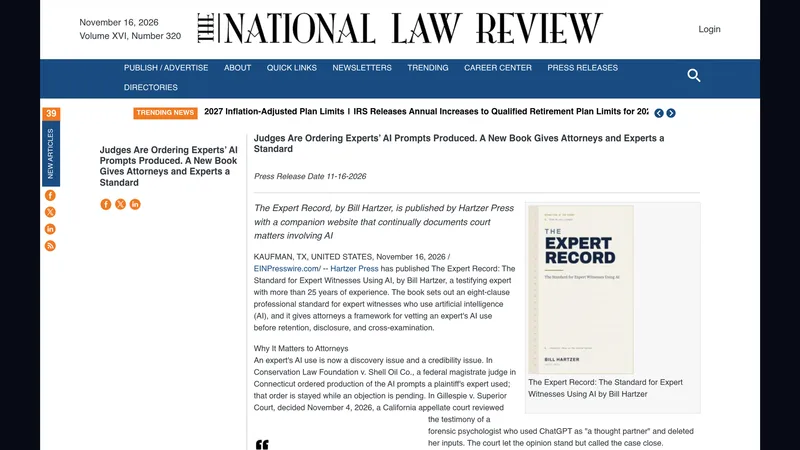
New book offers a standard for expert witnesses using AI and prompts courts to require AI prompt records

Source-page capture accompanying New book offers a standard for expert witnesses using AI and prompts courts to require AI prompt records

AI-generated summary Hartzer Press released a new book titled The Expert Record: The Standard for Expert Witnesses Using AI by Bill Hartzer, which outlines an eight-clause professional standard for expert witnesses using artificial intelligence. The publication provides a checklist for attorneys and highlights recent court cases involving artificial intelligence prompt disclosures, including Conservation Law Foundation v Shell Oil Co and Gillespie v Superior Court.

Character.ai's $10m sale hinges on moving chats without further consent

AI-generated summary Character Technologies filed a signed contract for a $10 million sale of Character.ai to Smirks and Pangs Acquisition LLC in the US Bankruptcy Court for the District of Delaware. The agreement requires a court order allowing the transfer of user chats and account data without further consent and shielding the buyer from past liability.

Also covered byBloomberg Law AI
Earlier:

AlphaProof Code verified Signal down to the machine code, and the specification is now what you have to trust

AI-generated summary Google DeepMind has used AlphaProof Code and teams of AI agents to write a machine-checked proof that the encryption code behind libsignal keeps its main security promises. The verification ran on the compiled machine code of version 0.105.4 with the spqr 1.6.0 module, producing about 6.5 million lines of Lean without any human writing proof code.

Also covered byEdTech Innovation Hubtechailatest.news
Earlier:

South Korean ruling party to push 10‑year ban for AI‑assisted exam cheating

Source-provided image accompanying South Korean ruling party to push 10‑year ban for AI‑assisted exam cheating

AI-generated summary South Korea’s ruling Democratic Party plans to draft legislation that would impose a ten-year ban on individuals caught using artificial intelligence tools to cheat on national examinations. The proposal follows a recent scandal involving the top scorer on the national tax accountant exam admitting to using a micro-camera and AI-assisted devices to cheat.

Also covered byYonhap News AgencyAI Affairs
Earlier: