
AI for Science · Mon 9 Nov

AI for Science refers to the application of machine learning methods to accelerate scientific discovery and research workflows across academic and industrial laboratories. Truncated covers research papers, computational biology tools, materials discovery models, and laboratory automation updates.

Monday 9 November

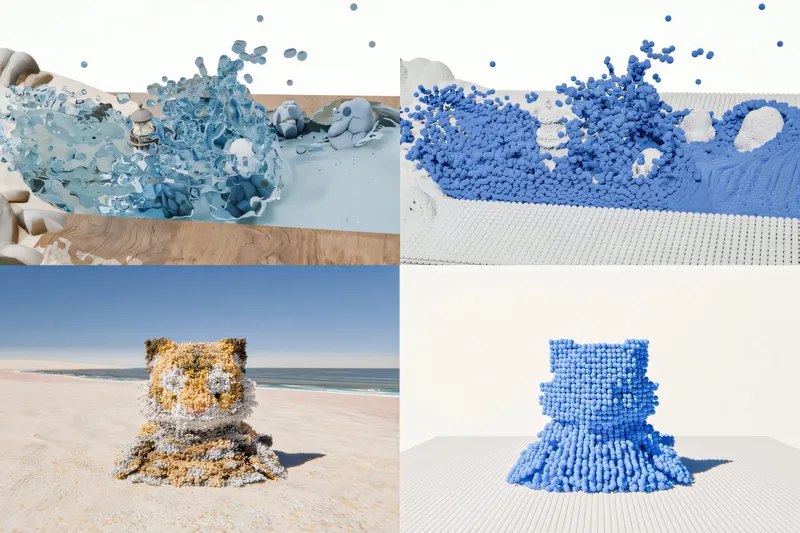
A single AI model simulates the behavior of many substances, from sliding sand to folding proteins

AI-generated summary Researchers at MIT, the University of British Columbia, and other institutions developed a single deep-learning system named WorldParticle to simulate physical processes like sliding sand and folding proteins. The system represents simulated materials as tiny particles and predicts their movement step by step, allowing engineers to model multiple physical phenomena with one unified architecture.

Import AI 480: Self-sustaining space economies; AI for science progress, and Meta builds perfect hands for a superintelligence

AI-generated summary Physical Superintelligence reports that an internal research system running an Anthropic model has proved a quantum computing conjecture from Scott Aaronson and Andris Ambainis. Meta Reality Labs Research has published details on Tactus, a textile-integrated tactile and pose sensing glove designed for naturalistic manipulation data collection.

Pierre Fabre Taps XtalPi’s AI and Robotics for Drug Discovery

AI-generated summary Laboratoires Pierre Fabre and XtalPi announced an agreement on November 9, 2026, to discover novel small-molecule clinical candidates using artificial intelligence and robotics. XtalPi will provide artificial intelligence capabilities and a robotics platform for de novo design, while Laboratoires Pierre Fabre will select and advance compounds in oncology, dermatology, and rare diseases.