
World Models

World models are artificial intelligence systems trained to simulate physical environments and predict future states based on current actions. Truncated covers research papers, architectural designs, simulation benchmarks and practical applications for robotics and autonomous systems.

Yesterday · Wed 11 Nov

Using wearables to enable cardiovascular-kidney-metabolic (CKM) risk profiling for personalized coaching

AI-generated summary Google Research introduces an investigational machine learning framework that translates passive wearable signals into a modifiable coachable health age to track early cardiovascular-kidney-metabolic health. Google Research says the framework uses an action-conditioned world model to simulate personalized 12-week what-if habit trajectories and expands to routine blood biomarkers.

PAN 2 world model: hardware, licensing and limits

AI-generated summary The Institute of Foundation Models at MBZUAI announced the release of PAN 2, providing researchers with an open video simulator that includes model weights along with training and inference code. The model uses a 29 billion parameter diffusion model alongside a Qwen3.5-9B text encoder and a Wan 2.2 VAE to generate video clips up to 20 seconds long.

Also covered by Writeble llms.blog

Tuesday 10 November

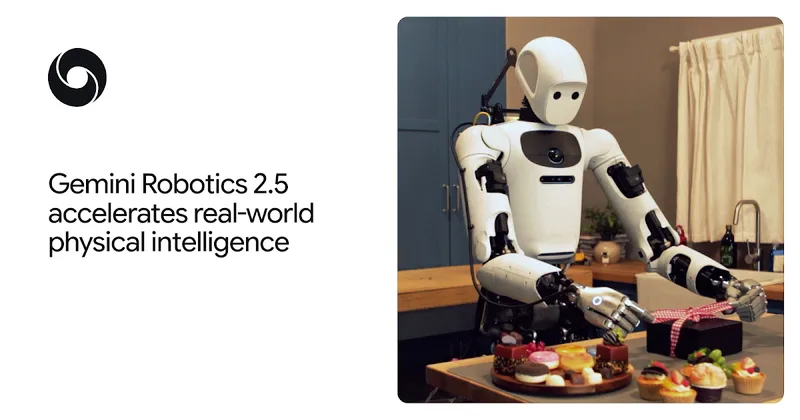
Gemini Robotics 2.5: Accelerating Physical Intelligence

AI-generated summary Google DeepMind reports that Gemini 4 Argon robotics research capabilities acted as a simulation engine to accelerate the development of Gemini Robotics 2.5. Google DeepMind says Argon generates simulated practice runs from camera scenes and builds digital twins to help robots generalize to new objects.

Also covered by @GoogleDeepMind Ars Technica The Decoder
+3 moreInteresting Engineering Tech Times SiliconANGLE

Monday 9 November

Insight about how 'nature makes no leaps' promises better robot predictions

AI-generated summary Machine learning researchers have developed a technique to help physical AI systems and robots make zero-shot physics inferences using counterfactual world models. Randall Balestriero of Brown University and AMI Labs, Kerda Varaku, and Yann LeCun describe the approach in a pre-print paper titled Counterfactual World Models: Natura Non Facit Saltus.

A single AI model simulates the behavior of many substances, from sliding sand to folding proteins

AI-generated summary Researchers at MIT, the University of British Columbia, and other institutions developed a single deep-learning system named WorldParticle to simulate physical processes like sliding sand and folding proteins. The system represents simulated materials as tiny particles and predicts their movement step by step, allowing engineers to model multiple physical phenomena with one unified architecture.

CoRL 2026 Robot Learning Conference Opens Monday: Li's World Models vs Tedrake's Factory Robots

Robot

AI-generated summary The Conference on Robot Learning features keynotes comparing Fei-Fei Li's world models from World Labs with Russ Tedrake's factory-trained behavior models from Walden Robotics. World Labs describes Atlas as a multimodal autoregressive diffusion transformer that generates 3D scenes, while Walden Robotics reports its robots have worked in a Toyota plant.

Sunday 8 November

Friday 6 November

AGIBOT Unveils GO-3 Preview Robot Model: Predicts Outcomes Before Acting, Rankings Self-Reported

Go-30 Preview

AI-generated summary AGIBOT unveiled its GO-3 Preview robot model on Oct. 29 at its Innovation Day in Shanghai, featuring a system built on a world reasoning action model. AGIBOT says the model ranks first on three benchmarks, though the company supplied those rankings itself and has not yet released the weights or code to the public.

Thursday 5 November

Build World Models for Interactive Simulation with NVIDIA Cosmos

AI-generated summary NVIDIA released Cosmos, a platform of world foundation models and development tools designed to address physical AI challenges. NVIDIA says Cosmos Framework provides agent skills and recipes for training, while Cosmos NIM microservices support GPU-accelerated serving.

Also covered by @NVIDIAAI huggingface.co Forkast
+1 moreTopFive

Wednesday 4 November

LiberAI Unveils Liber-0, a World Action Model That Grounds Human Experience in Robot Action

AI-generated summary LiberAI announced Liber-0, a world action model pretrained on more than 2.2 million hours of human experience to support zero-shot robot manipulation. LiberAI says the model achieved an overall success rate of 36.0% across 60 tasks evaluated in 600 trials without robot demonstrations collected specifically for those target tasks.

Monday 2 November

42AI comes out of stealth with $62.5M and a world model that can 'predict human behavior'

AI-generated summary Israeli startup 42AI has launched with $62.5 million in seed funding and a behavioral world model designed to predict human behavior. The company is initially running its predictive system at a handful of financial brokerages to help predict how individual traders will respond to volatile conditions.

Also covered by SiliconANGLE